GUIDE · LAMPFORGEWhich LED fits a Lampforge lamp, and how to fit your own
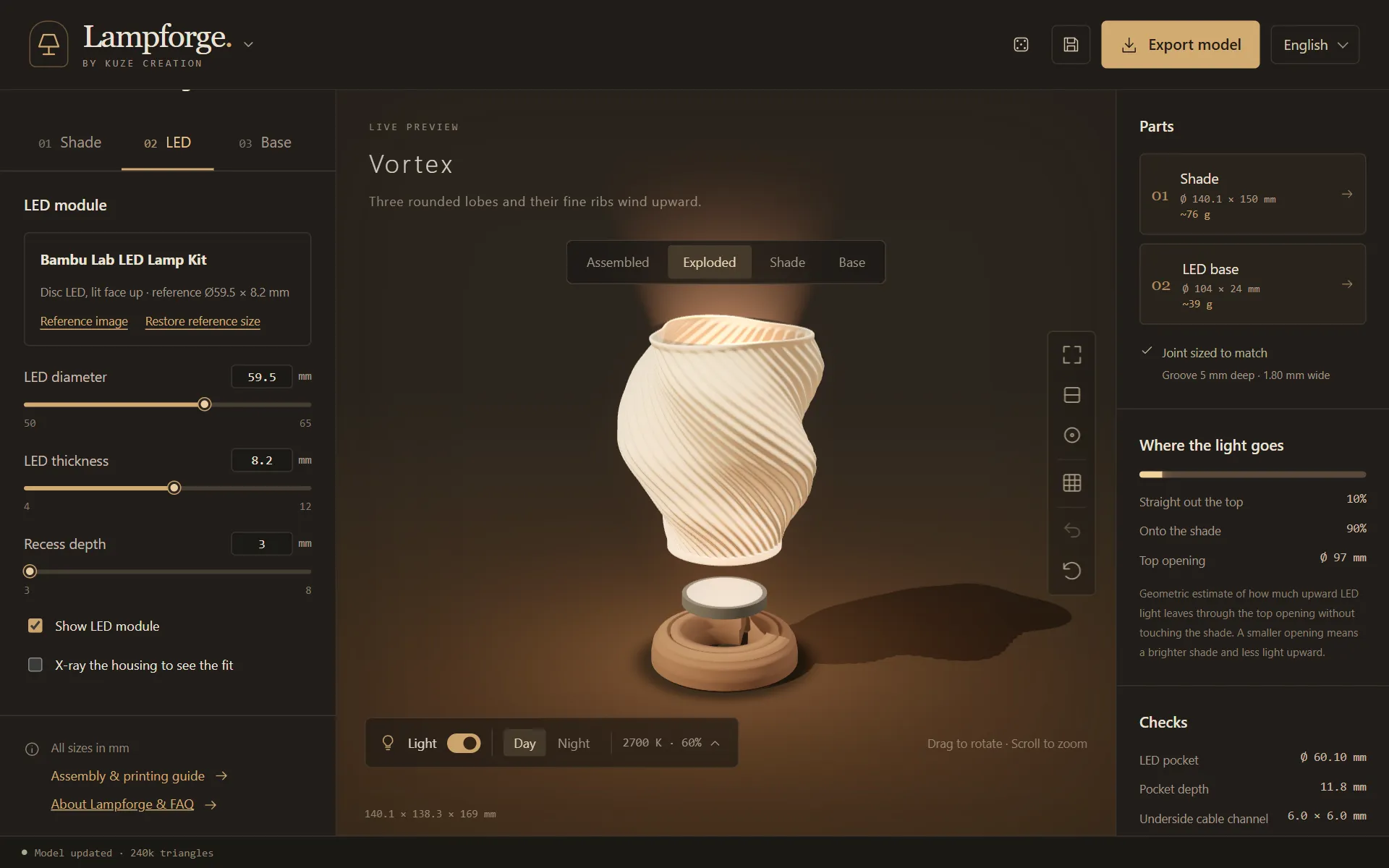
KUZE Lampforge is built round one LED: the round, flat module of the Bambu Lab LED Lamp Kit, 59.5 mm across and 8.2 mm thick, with a cable. Every lamp starts sized for it. Any other round, flat LED module from 50 to 65 mm across and 4 to 12 mm thick fits too: measure it, type its size under LED module, and the pocket, the ledge it rests on and the base follow. The LED and cable are not part of the print.
How the LED sits in the base
The LED goes in face-up, into a pocket at the top of the base, under the shade. It rests on a narrow ledge, and the base is open underneath, so you can push the LED out from below. Its cable drops down a slot beside the pocket and leaves along a channel under the base, at the back; on the Tripod base it passes through a slot in the ring and hangs between the back legs. Turn on Show LED module to see it in place.
Fitting a different LED
Measure it
Measure the LED's diameter and its thickness with calipers, and the thickness of its cable. A disc 50 to 65 mm across and 4 to 12 mm thick fits.
Type its size
Under LED module, set LED diameter and LED thickness. The pocket is sized from them, and the base grows taller if it has to. Restore reference size goes back to the 59.5 × 8.2 mm module.
Set the depth
Recess depth, 3 to 8 mm, sets how far down in the base the LED sits. With a thin LED, Lampforge keeps the pocket at least 9.5 mm deep.
Check the cable
Under the base's Fit tolerances, set Underside cable channel (Cable slot width on the Tripod) wider than your cable: 4 to 10 mm, 6 mm to start.
Fit tolerances
On the base, Fit tolerances holds every gap. Each clearance is per side.
- LED clearance (per side)
- The gap round the LED in its pocket: 0.15 to 0.8 mm, 0.3 mm to start.
- Extra pocket depth
- A little more depth in the pocket than the LED is thick: 0.3 to 1.5 mm, 0.6 mm to start.
- LED support ring width
- How far the ledge reaches in under the LED's edge: 2 to 6 mm, 3 mm to start. The opening inside it is where you push the LED out.
- Shade joint clearance
- The gap round the shade in the groove on top of the base: 0.15 to 0.6 mm, 0.3 mm to start.
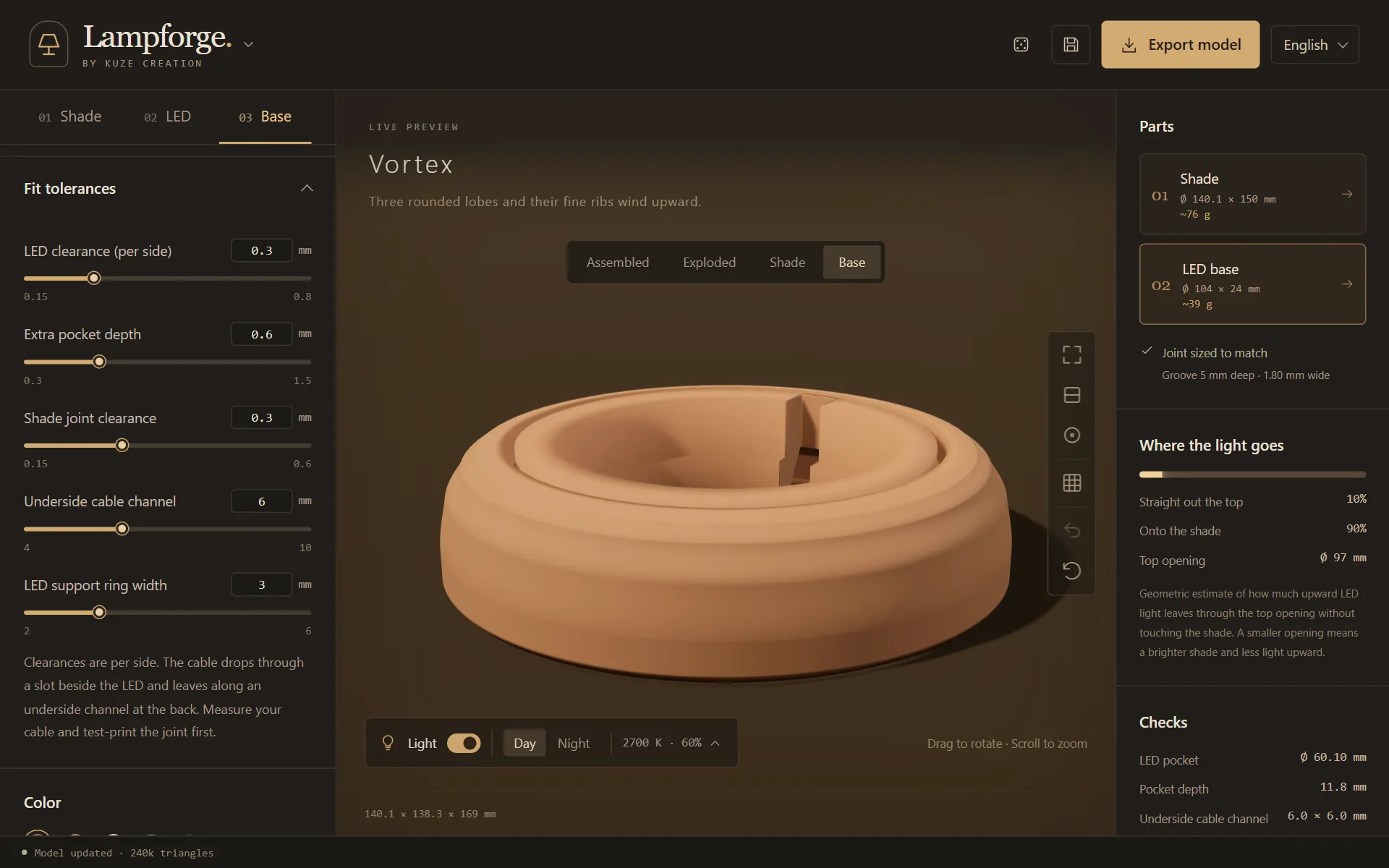
Print the base first. It is the quicker part, and it shows whether the LED and the cable fit before you spend hours on the shade.
Light colour and brightness
Lampforge's colour temperature (2200 to 6500 K, 2700 K to start) and brightness only change the preview. The real light is your LED's: set the preview to match it. The shade changes it too: a thinner wall and a lighter filament let more light through, and the light takes on the shade's colour. For the shade, print it in spiral vase mode, as the lamp print settings guide explains.
Lampforge has not been tested for heat with anything but an LED module. Do not fit an incandescent or halogen bulb.
Questions
Which LED does a Lampforge lamp use?
A round, flat LED module 59.5 mm across and 8.2 mm thick, the one in the Bambu Lab LED Lamp Kit, with its cable. The base has a pocket for it, a ledge it rests on, an open bottom to push it out and a channel that leads the cable out the back.
Can I use a different LED?
Yes, if it is a round, flat module 50 to 65 mm across and 4 to 12 mm thick. Measure it and type its diameter and thickness under LED module; the pocket, the ledge and the height of the base follow.
Is the LED in the download?
No. The download has the shade and the base; the LED and its cable are only in the preview. Buy the LED separately.
The LED is tight or loose in the base. What do I change?
Change LED clearance (per side) under Fit tolerances and download the base again. It starts at 0.3 mm a side: lower it if the LED rattles, raise it if it will not go in.
Can I use a light bulb instead?
No. Lampforge is made for a flat LED module and has not been tested for heat with anything else. Do not fit an incandescent or halogen bulb.
Free to design, nothing to install. Next: slicer settings for a lamp, or all guides.